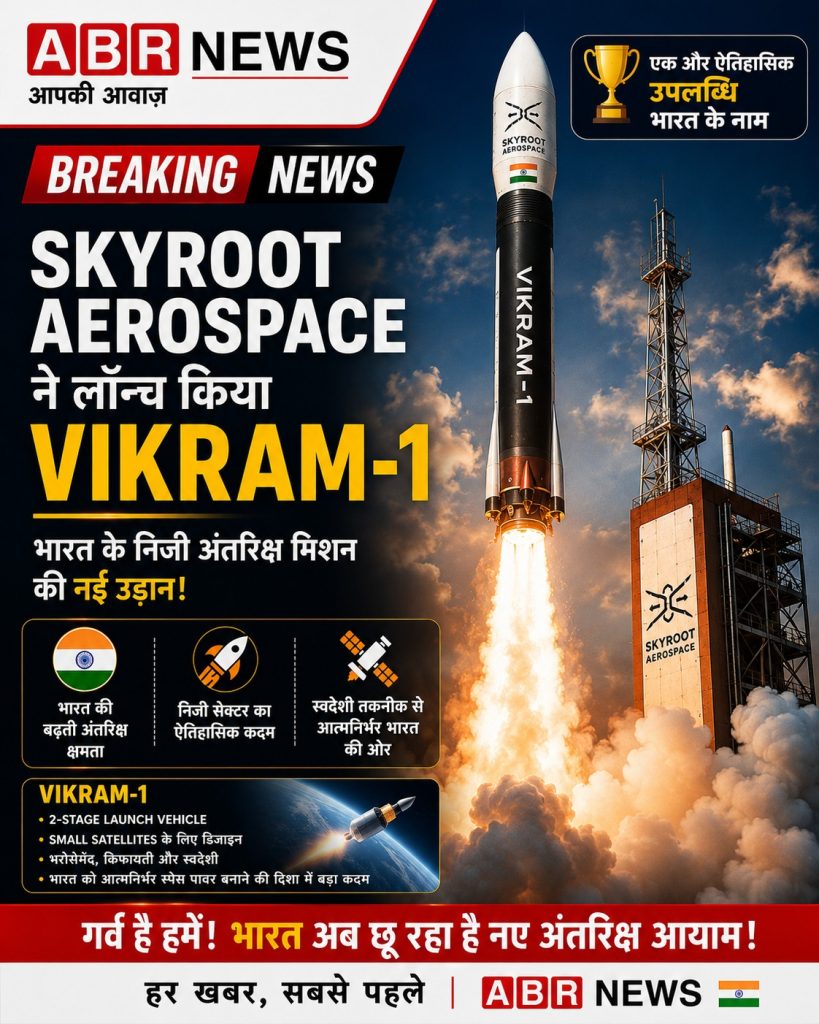
Skyroot Aerospace Vikram-1 Launches India has achieved another historic milestone in its space journey as Skyroot Aerospace successfully launched Vikram-1, the country’s first privately developed orbital launch vehicle. The mission, named Mission Aagaman, represents a significant breakthrough for India’s growing private space sector and reinforces the nation’s ambition to become a global leader in commercial space launches.
The successful launch demonstrates how India’s private aerospace companies are rapidly evolving alongside the Indian Space Research Organisation (ISRO). It also marks a major step toward opening new opportunities for satellite launches, technological innovation, and international collaborations in the global space economy.
India Enters a New Era of Private Space Exploration
For decades, ISRO has been the driving force behind India’s remarkable achievements in space technology. However, after the Indian government’s space sector reforms, private companies were allowed to participate more actively in satellite launches and space technology development.
Skyroot Aerospace has now become the first Indian private company to successfully launch an orbital rocket, proving that India’s startup ecosystem is capable of delivering world-class aerospace innovation.
The success of Vikram-1 is expected to encourage more private investments and accelerate the country’s commercial space ambitions.
What is Vikram-1?
Vikram-1 is a four-stage orbital launch vehicle developed entirely by Skyroot Aerospace. It has been designed primarily for launching small satellites into Low Earth Orbit (LEO).
The rocket uses advanced carbon composite materials, making it lightweight, efficient, and cost-effective for commercial satellite launches.
Unlike traditional government-operated launch vehicles, Vikram-1 has been developed with a focus on rapid manufacturing, lower operational costs, and higher launch flexibility.
Key Features of Vikram-1
Some of the major highlights of Vikram-1 include:
- India’s first privately developed orbital launch vehicle
- Designed for launching small satellites into Low Earth Orbit
- Lightweight carbon composite structure
- Cost-effective commercial launch solution
- Multi-stage launch system for higher efficiency
- Built using advanced aerospace technologies
- Supports domestic as well as international satellite missions
These features position Vikram-1 as a competitive option in the rapidly growing global small satellite launch market.
About Mission Aagaman
Mission Aagaman is Skyroot Aerospace’s maiden orbital mission. The objective of this mission is to demonstrate the company’s capability to deliver payloads into orbit while validating multiple indigenous technologies developed over the past several years.
The mission also showcases India’s expanding private participation in the global space industry, where demand for affordable satellite launch services continues to rise.
Industry experts believe that successful completion of Mission Aagaman will significantly strengthen India’s position in the commercial launch market.
Skyroot Aerospace: India’s Rising Space Startup
Founded in 2018 by former ISRO scientists, Skyroot Aerospace is headquartered in Hyderabad and has quickly emerged as one of India’s leading space technology startups.
The company first gained national recognition after successfully launching Vikram-S, India’s first privately built suborbital rocket. That mission demonstrated the startup’s technical capabilities and laid the foundation for the development of Vikram-1.
With the successful orbital launch, Skyroot has now entered an elite group of private space companies capable of independently developing orbital launch vehicles.
Why This Launch is Important for India
The successful launch of Vikram-1 is much more than a technological achievement. It represents a major shift in India’s space ecosystem.
1. Strengthening Private Participation
The mission proves that Indian private companies can build advanced launch vehicles capable of competing globally.
2. Boosting the Space Economy
India aims to increase its share in the global space economy over the coming years. Successful private launches will attract both domestic and international investments.
3. Creating Employment
Growth in the private aerospace sector will generate thousands of highly skilled jobs in engineering, manufacturing, research, and technology.
4. Supporting Startup Innovation
The success of Skyroot Aerospace is expected to inspire many Indian startups to enter the aerospace and deep-tech sectors.
5. Expanding Commercial Opportunities
Affordable satellite launches are becoming increasingly important worldwide. Vikram-1 gives India another competitive advantage in offering low-cost launch services.
Government’s Vision for the Space Sector
The Indian government has introduced several reforms to encourage private participation in the space industry.
Organizations like IN-SPACe have been established to support private companies by providing access to testing facilities, launch infrastructure, and regulatory approvals.
These reforms have enabled startups like Skyroot Aerospace to innovate and compete globally.
Global Impact of Vikram-1
The demand for launching small satellites is increasing rapidly due to advancements in communication, Earth observation, navigation, and scientific research.
Countries and private organizations are looking for affordable launch providers, and India’s competitive pricing makes it an attractive destination.
With Vikram-1, Skyroot Aerospace is expected to attract customers from around the world, further strengthening India’s reputation as a reliable commercial launch partner.
What Lies Ahead?
Following the success of Mission Aagaman, Skyroot Aerospace is expected to expand its launch capabilities and develop future launch vehicles for heavier payloads.
The company also aims to establish regular commercial launch services, enabling businesses, research institutions, and governments to deploy satellites more efficiently.
Experts believe that India’s private space industry is only at the beginning of its growth journey, and many more successful missions are expected in the coming years.
Conclusion
The successful launch of Vikram-1 is a defining moment in India’s space history. It symbolizes the country’s transition from a government-led space program to a collaborative ecosystem where private innovation plays a vital role.
Skyroot Aerospace has demonstrated that Indian startups can build world-class launch vehicles capable of competing on the global stage. As India’s private space industry continues to grow, missions like Vikram-1 will play a crucial role in shaping the future of commercial space exploration.
FAQs:
1. What is Vikram-1?
Vikram-1 is India’s first privately developed orbital launch vehicle built by Skyroot Aerospace for launching small satellites into Low Earth Orbit.
2. What is Mission Aagaman?
Mission Aagaman is Skyroot Aerospace’s first orbital mission, designed to demonstrate the capabilities of the Vikram-1 launch vehicle.
3. Why is Vikram-1 important for India?
It marks the first successful orbital launch by an Indian private company, strengthening India’s private space ecosystem and commercial launch capabilities.
4. Who founded Skyroot Aerospace?
Skyroot Aerospace was founded in 2018 by former ISRO scientists and is headquartered in Hyderabad, India.
5. How will Vikram-1 benefit India’s space industry?
The mission will encourage private investment, boost commercial satellite launches, create employment opportunities, and strengthen India’s position in the global space economy.
Related News: Business News | Mumbai News | Sports News | Home