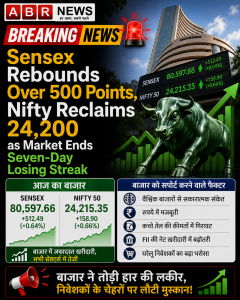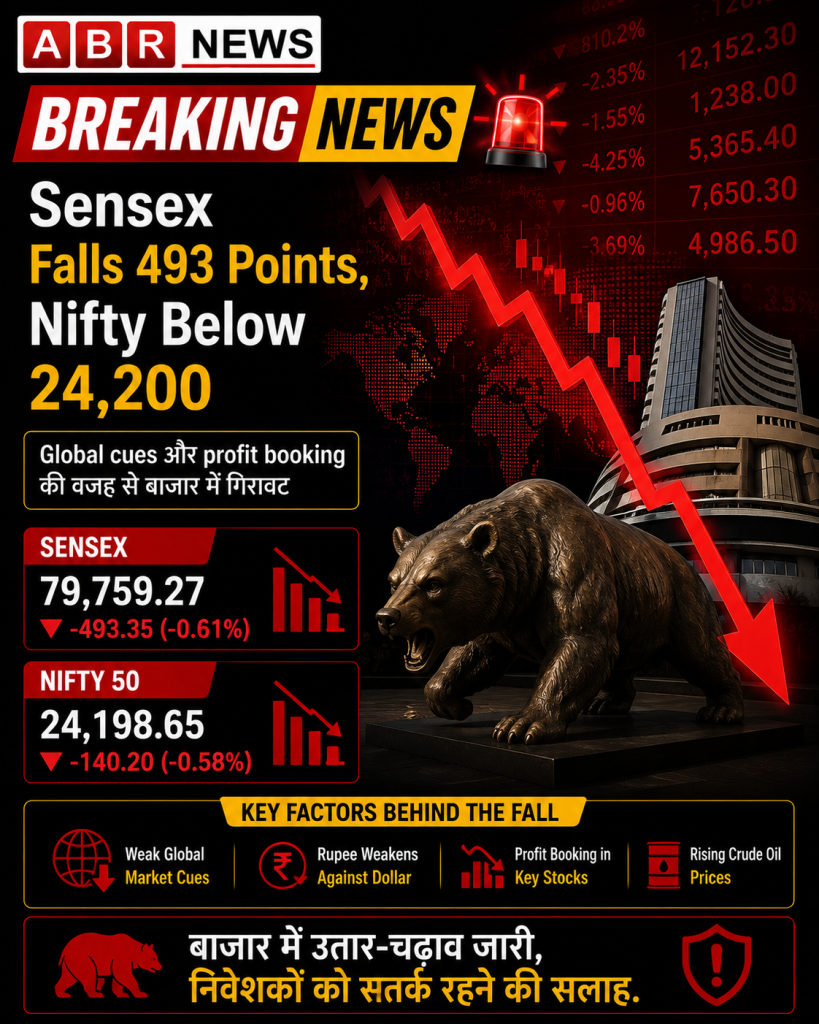
August 18, 2026: Indian stock markets ended sharply lower on Tuesday as continued geopolitical tensions in West Asia and rising crude oil prices weighed on investor sentiment. The Nifty 50 declined for the sixth consecutive trading session, while the Sensex also extended its recent losing streak.
Sensex And Nifty Fall Down
The BSE Sensex fell 492.70 points, or 0.63%, to close at 77,235.46. The index remained under pressure throughout the session, with selling visible across several major sectors.
The Nifty 50 declined 132.75 points, or 0.55%, to settle at 24,154.90, marking its sixth straight session of losses.
The continued weakness has made investors cautious as they assess the impact of global developments on Indian equities.
Crude Oil Prices Add to Market Pressure
One of the major concerns for investors was the rise in crude oil prices. Brent crude was trading around $91 per barrel, adding pressure to markets because higher oil prices can increase India’s import costs and create inflationary concerns.
The rise in oil prices was linked to continued uncertainty surrounding the conflict and stalled diplomatic efforts in West Asia.
IT Stocks Drag the Market
IT stocks were among the major contributors to Tuesday’s decline.
Infosys, HCL Technologies and Wipro were among the notable Nifty losers, while Asian Paints and Tata Motors Passenger Vehicles also faced selling pressure.
The IT sector’s weakness added to the pressure on the benchmark indices.
Which Stocks Gained?
Despite the broader market decline, some stocks managed to close higher.
Axis Bank, Power Grid Corporation, Mahindra & Mahindra and Bajaj Finance were among the stocks that showed relative strength during the session.
This indicates that investors continued to selectively buy stocks even as overall market sentiment remained weak.
Why Is the Indian Stock Market Falling?
Several factors are currently influencing the market:
- Rising crude oil prices
- Geopolitical tensions in West Asia
- Uncertainty around a potential peace agreement
- Weakness in IT and other major sectors
- Continued foreign investor selling
- Higher global bond yields
These factors have increased risk aversion among investors and contributed to the recent decline in benchmark indices.
Nifty 50 Key Levels to Watch
After Tuesday’s close at 24,154.90, market participants are watching the 24,100 area as an important near-term support zone.
On the upside, 24,300 is being watched as an immediate resistance level. A sustained recovery above resistance could improve sentiment, while continued weakness near support may keep volatility elevated.
What Should Investors Watch Next?
Investors will continue to monitor crude oil prices, developments in West Asia, global markets and foreign institutional flows.
With the Nifty already recording six consecutive sessions of losses, traders are likely to closely watch whether the index can stabilise around current levels or face further selling pressure.
Long-term investors may want to focus on company fundamentals and valuations rather than making decisions based solely on short-term market movements.
Conclusion
The Indian stock market remained under pressure on August 18, 2026, with the Sensex falling nearly 493 points and the Nifty closing below 24,200. Rising crude oil prices and geopolitical uncertainty remained the major factors affecting investor sentiment.
The next few trading sessions will be important for determining whether the market can find support or continue its recent downward trend.
FAQs
1. How much did the Sensex fall today?
The Sensex fell 492.70 points, or 0.63%, to close at 77,235.46.
2. Where did the Nifty 50 close?
The Nifty 50 closed at 24,154.90, down 132.75 points.
3. Why did the Indian stock market fall today?
Rising crude oil prices and continuing geopolitical tensions in West Asia were among the major factors affecting market sentiment.
4. How many sessions has the Nifty declined consecutively?
The Nifty 50 recorded its sixth consecutive session of decline on August 18.
5. What Nifty levels should investors watch?
The 24,100 support and 24,300 resistance zones are being closely watched for near-term market direction.