Published: 6 August 2026
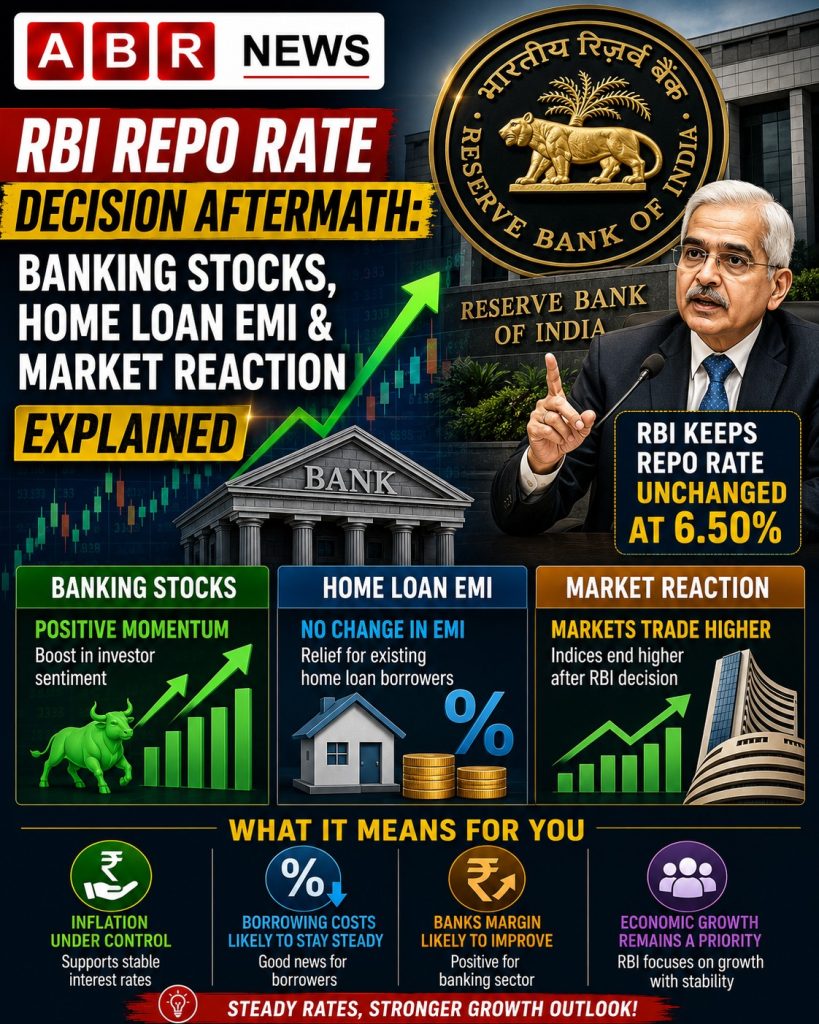
The Reserve Bank of India (RBI) has kept the repo rate unchanged at 5.25%, maintaining its cautious approach toward inflation and economic growth. While the decision was widely expected, investors closely watched the central bank’s commentary for future policy signals.
Following the announcement, the Indian stock market witnessed mixed movements, with banking stocks remaining in focus as analysts assessed the impact on lending, borrowing, and overall economic growth.
RBI Keeps Repo Rate Unchanged
The Monetary Policy Committee (MPC) decided to maintain the repo rate at 5.25%, aiming to balance inflation control with economic stability.
Key Highlights
- Repo Rate remains at 5.25%
- Inflation continues to be closely monitored.
- RBI maintains a cautious policy stance.
- Future decisions will depend on economic data.
What Does It Mean for Home Loan Borrowers?
Since there has been no change in the repo rate:
- Home loan EMIs are expected to remain unchanged.
- Existing borrowers are unlikely to see immediate changes in monthly repayments.
- Banks may continue offering loans at current interest rates.
- New borrowers can expect stable lending conditions.
Banking Stocks Stay in Focus
The RBI’s policy announcement kept banking and financial stocks under the spotlight.
Market experts observed:
- Private banking stocks saw mixed movement.
- Public sector banks traded with moderate gains.
- Investors remained focused on future interest rate expectations.
- Financial institutions continue to benefit from stable credit demand.
Market Reaction
Indian equity markets reacted cautiously after the RBI policy.
- Sensex traded with limited gains.
- Nifty remained range-bound.
- Banking and financial stocks witnessed higher trading activity.
- Investors now await upcoming inflation and GDP data.
Expert View
Economists believe the RBI is prioritizing macroeconomic stability while ensuring inflation remains under control.
According to market analysts:
- Stable interest rates support business confidence.
- Housing demand may remain steady.
- Future RBI decisions will depend on inflation trends and global economic developments.
Impact on the Economy
A stable repo rate provides predictability for businesses and consumers.
Potential benefits include:
- Stable borrowing costs.
- Continued investment activity.
- Improved consumer confidence.
- Support for overall economic growth.
Conclusion
The RBI’s decision to maintain the repo rate at 5.25% reflects a balanced approach toward inflation and growth. While home loan borrowers may not see immediate EMI changes, banking stocks and financial markets will continue reacting to future policy guidance and macroeconomic indicators.
FAQs
Q1. What is the current RBI repo rate?
The RBI has maintained the repo rate at 5.25%.
Q2. Will home loan EMIs increase?
No immediate increase is expected since the repo rate remains unchanged.
Q3. Why are banking stocks in focus?
Interest rate decisions directly affect banks’ lending, profitability, and credit growth.
Q4. How did the stock market react?
Sensex showed limited gains while banking stocks remained actively traded.
Q5. What will RBI monitor before its next policy meeting?
Inflation, GDP growth, global economic conditions, and financial stability.
Get the latest news with accuracy and trust. Stay updated with top stories from India, the world, Mumbai, Maharashtra, business, the stock market, technology, and entertainment—all in simple language with clear and reliable analysis.
Related News